
Fire Safety in Home and Office Design: Why It Should Never Be an Afterthought
When designing a house, office, showroom, school, restaurant, or commercial building, most people focus first on aesthetics — the elevation, furniture, flooring, ceiling, lighting, glass work, colour palette, and luxury finishes. But one of the most critical elements of architectural design is often overlooked at the planning stage: fire safety. Fire safety isn't just a technical compliance checkbox. It's a life-saving design requirement. A beautiful building only delivers real value when the people living or working inside it are safe. This guide breaks down everything architects, homeowners, and business owners should know about integrating fire safety into building design — from staircases and exits to sprinklers and signage.
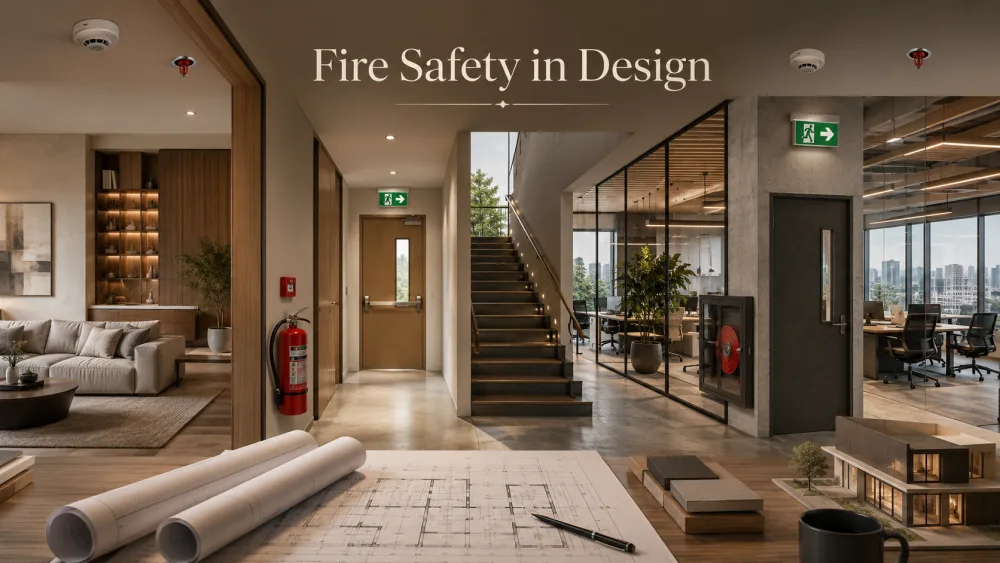
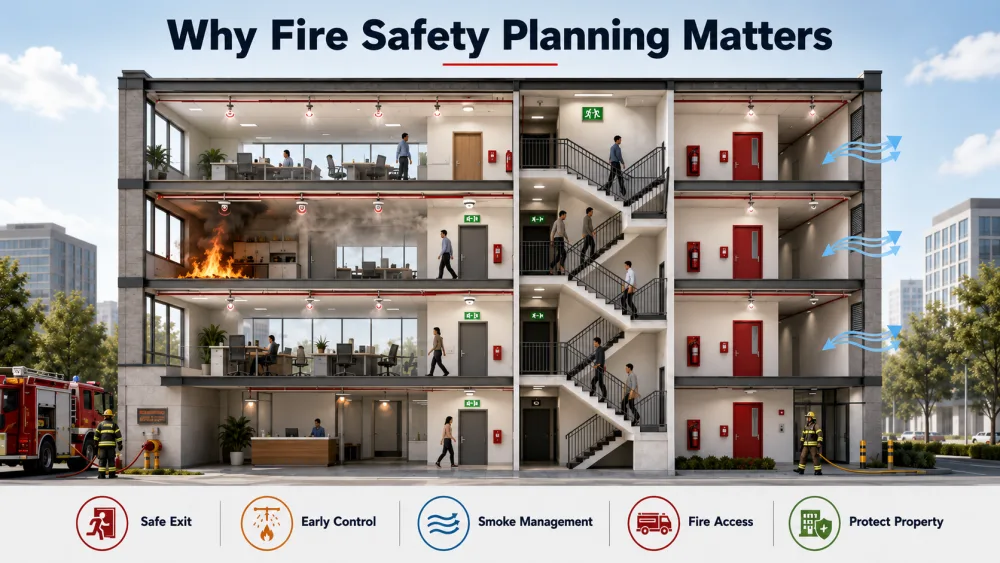
Why Fire Safety Planning Is Necessary in Every Building
Fire can break out for many reasons — an electrical short circuit, overloaded wiring, kitchen fire, AC load, server room equipment, loose electrical connections, candles, gas leakage, pantry mishaps, or careless use of appliances and machinery. In offices, the risk multiplies. A single floor can house dozens of computers, complex wiring systems, printers, pantry equipment, UPS units, servers, and HVAC systems running simultaneously. Without a clear fire safety plan, occupants can panic and struggle to find a safe way out during an emergency.
This is exactly why fire safety must be considered from the design stage — not added as a retrofit after construction is complete.
The Core Purpose of Fire Safety in Design
Good fire safety design exists to:
Save lives
Give occupants enough time to exit safely
Control fire at an early stage before it spreads
Reduce smoke movement throughout the building
Help fire-fighting teams access the building quickly
Protect property and important documents
Reduce panic during an emergency
Fire safety doesn't promise that fire will never happen. It ensures that if fire does happen, the building itself helps people escape safely while supporting fast fire control.
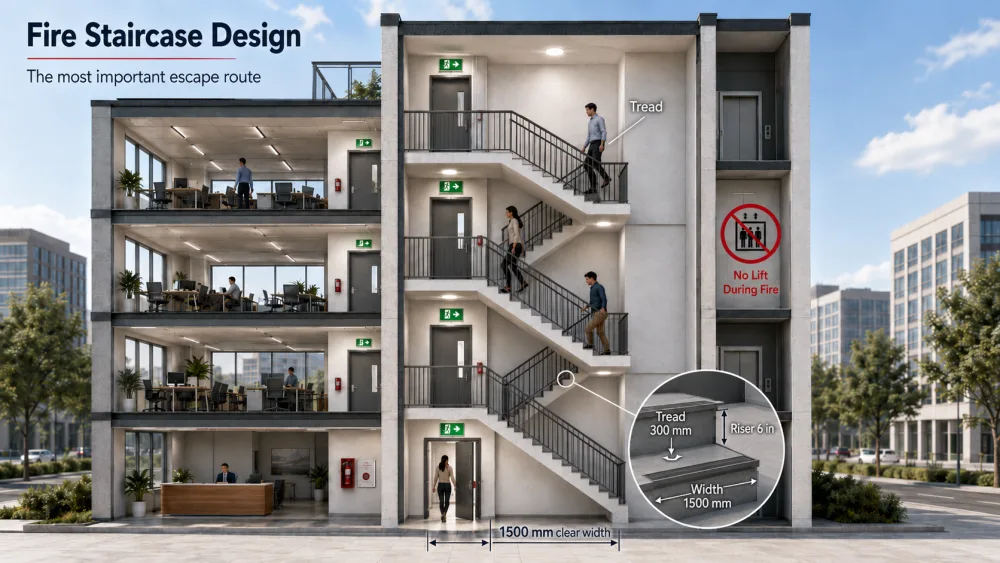
Fire Staircase Design: The Most Important Escape Route
In office and commercial buildings, the staircase is arguably the single most important fire safety element. A well-designed fire staircase needs to be wide enough for quick, safe movement during an emergency. As a general planning benchmark, commercial buildings should aim for a staircase width of around 1500 mm, though this can vary based on building size, height, and local fire codes. Comfort and usability matter too. A well-proportioned staircase typically uses a riser of around 6 inches and a tread of about 300 mm, allowing for smooth, safe movement even under stress.
It's also worth remembering: during a fire, lifts must never be used — only the staircase. For this reason, the fire staircase should never be treated as leftover or secondary space in a floor plan. It deserves clear, deliberate, and practical planning from day one.
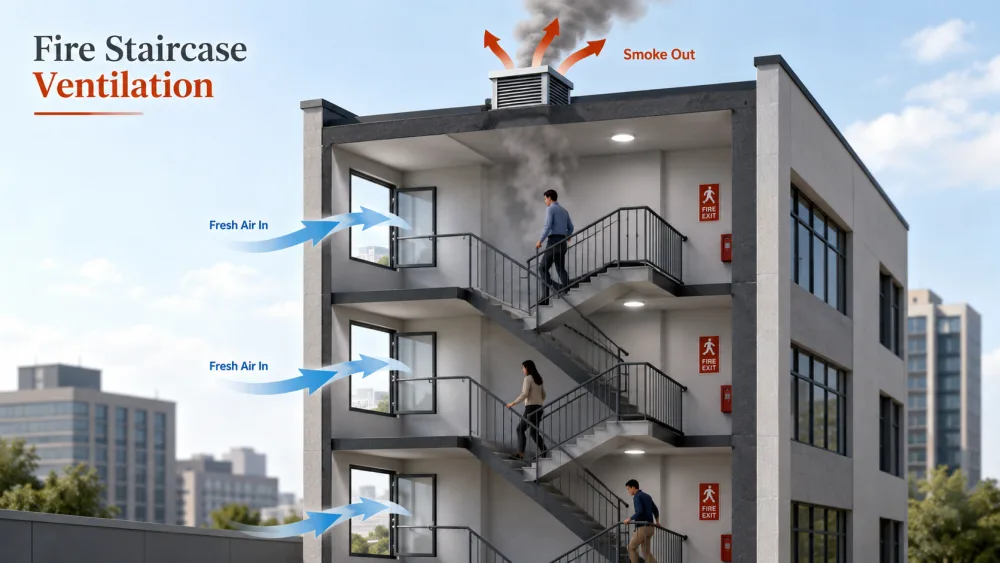
Why Ventilation in the Fire Staircase Matters
During a fire, smoke is often more dangerous than the flames themselves. If smoke gets trapped inside a staircase, people cannot breathe properly and cannot escape — turning the one safe route into a hazard. This is why every fire staircase needs proper ventilation. Wherever possible, openable windows should be provided at suitable levels. Where windows aren't feasible, alternatives like openable glass panels, a ventilated shaft, or a roof-level opening should be incorporated as per fire safety requirements.
The goal is simple: the staircase should never become a sealed smoke chamber. It must allow smoke to escape and fresh air to enter.
Fire-Rated Doors and Safe Passage Planning
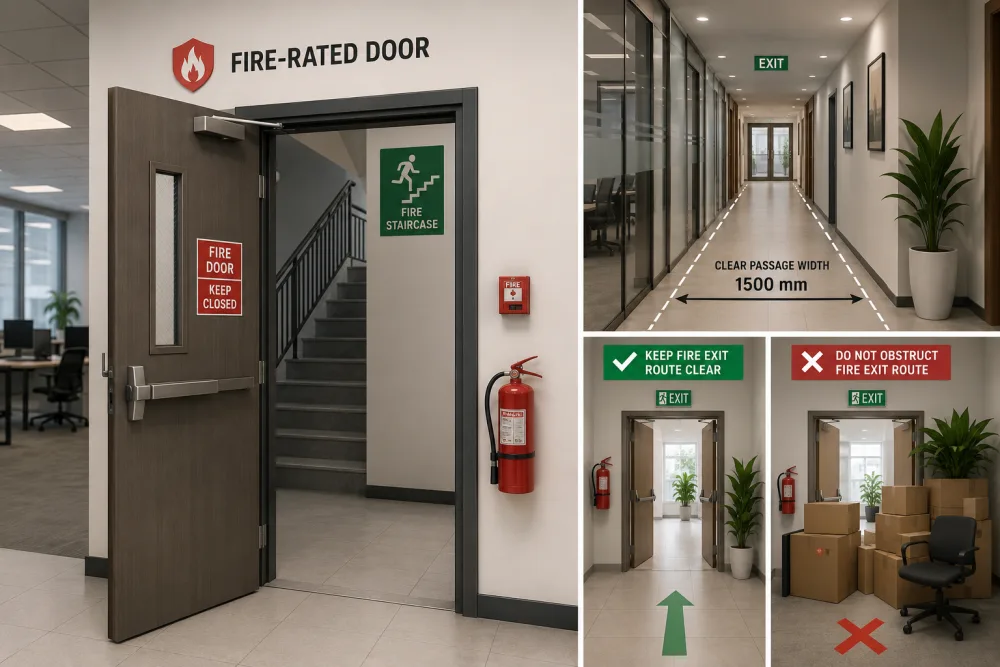
A fire-rated door positioned between the main office or living area and the fire staircase plays a critical role — it slows the spread of fire and smoke from one zone to another, buying occupants precious extra time.
Equally important are the passages leading to fire exits. For office and commercial buildings, a clear passage width of around 1500 mm (depending on local norms and occupancy load) helps people move quickly and safely during an emergency.
Just as critical: the fire exit route must always remain unobstructed. It should never be blocked by storage boxes, furniture, cartons, plants, loose chairs, or decorative items. A fire exit is only useful if people can actually use it the moment they need it.
Essential Fire-Fighting Equipment and Systems
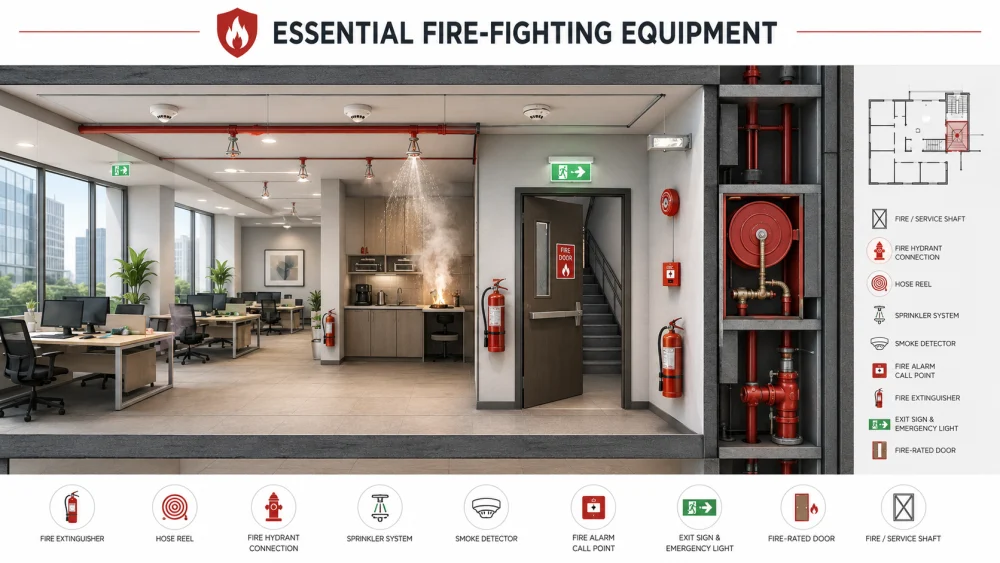
Every home, office, and commercial building needs basic fire-fighting infrastructure in place. Smaller buildings may only require fire extinguishers at key points, while larger buildings typically need a more comprehensive fire safety system, including:
Fire extinguishers
Hose reel systems
Fire hydrant systems
Sprinkler systems
Smoke detectors
Fire alarm systems
Emergency lighting
Exit signage
Fire-rated doors
Fire shaft and service planning
In office environments especially, smoke detectors and sprinklers are vital because fire may go unnoticed in the early stages — particularly in cabins, server rooms, pantry areas, or storage zones. A smoke detector provides early warning, while a sprinkler system helps contain the fire before it spreads out of control.
Why Architects and Fire Consultants Should Be Involved from Day One
Fire safety can't be planned in isolation or added as an afterthought. It needs to be coordinated across the entire building design — layout, staircase, passages, entry-exit points, electrical systems, HVAC, ceiling design, sprinkler placement, smoke detector locations, doors, and signage.
This is precisely why architects and fire consultants should be brought in from the earliest design stages. When fire safety is integrated into the original architectural plan, it can be woven into the design beautifully, without compromising aesthetics. Staircase location, fire exit doors, passage widths, glass openings, service shafts, fire-rated doors, and equipment placement should all be finalized during the planning phase.
When fire safety is added later as a retrofit, it almost always becomes more difficult, more expensive, and visually disruptive to the finished space.
Why Bigger Buildings Need Two Fire Exits
For larger commercial buildings, a single exit point is often not enough. If the floor area is large, or occupancy is high, building codes frequently require two separate fire exits.
A second fire exit is essential because if one route gets blocked during an emergency, occupants still have a safe alternative path out. Whether two exits are mandatory depends on plot size, total building area, height, occupancy levels, and local fire department regulations — but the underlying principle is non-negotiable: people should never be trapped inside a building because there's only one way out.
The Importance of Clear Fire Safety Signage
During a fire emergency, people panic — and panicked individuals don't stop to read long instructions. They look for clear, immediate direction.
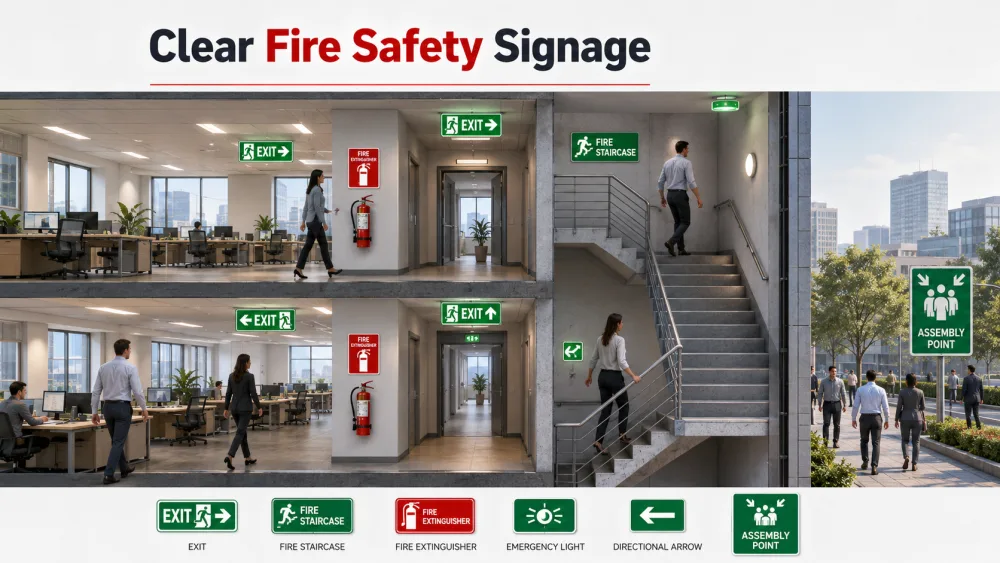
This makes fire exit signage one of the most underrated elements of fire safety design. Exit signs, staircase signage, extinguisher signs, emergency light indicators, and assembly point signs all need to be clearly visible at all times. Even a first-time visitor to a building should instantly understand where to go in an emergency.
Good signage saves time — and during a fire, every second counts.
Fire Safety Isn't Just for Commercial Buildings - Homes Need It Too
Fire safety planning isn't exclusive to offices and commercial spaces. Residential homes need it just as much.
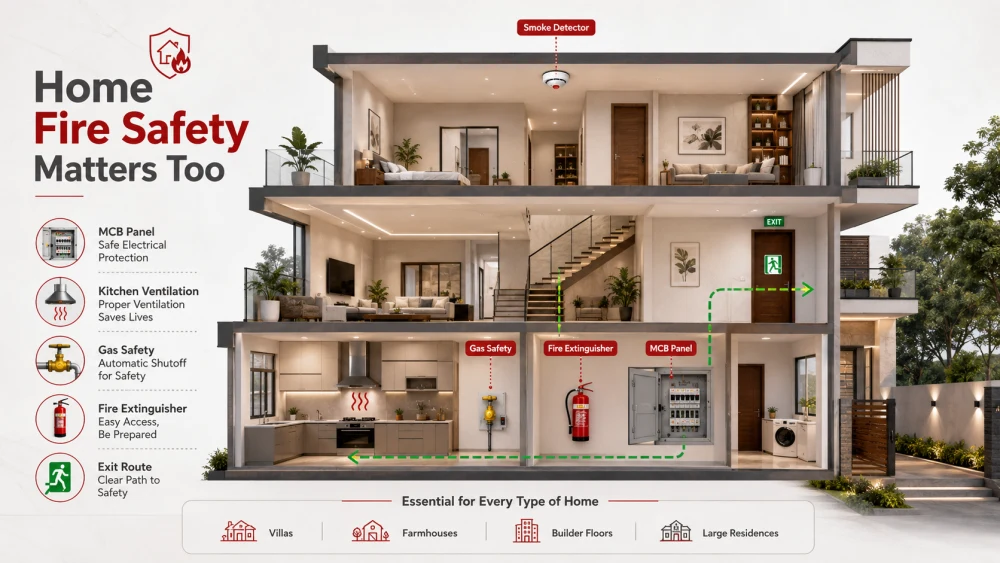
A well-planned home should include safe electrical wiring, good-quality MCBs, proper kitchen ventilation, gas safety measures, a fire extinguisher near the kitchen or utility area, and clearly defined exit routes.
This becomes even more important in villas, farmhouses, builder floors, and larger residences, where bigger floor areas can mean longer evacuation times. If we're investing in luxury interiors, it only makes sense to invest just as thoughtfully in safety.
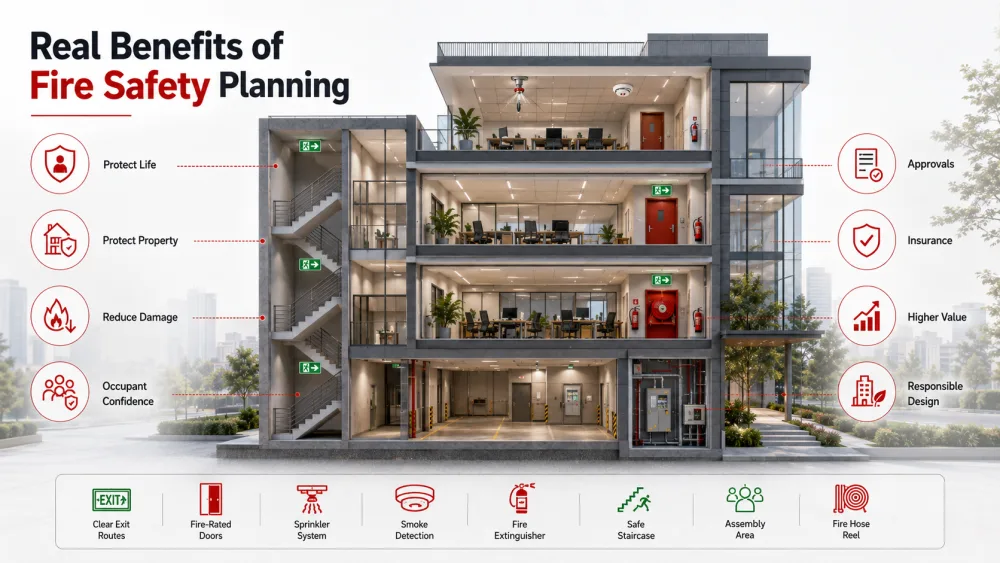
The Real Benefits of Fire Safety Planning
A well-executed fire safety plan delivers far more than compliance. It:
Protects life
Protects family members and staff
Protects property and assets
Reduces potential fire damage
Builds occupant confidence
Smooths the path to authority approvals
Supports insurance requirements
Improves overall building value
Reflects responsible, thoughtful design
A safe building will always hold more value than one designed purely for visual appeal.
Is There Any Downside to Fire Safety Planning?
There's no real downside to proper fire safety planning — only practical considerations around space, cost, and coordination.
A wider staircase may take up additional floor area. Fire-rated doors cost more than standard doors. Sprinklers and detectors require careful planning, and fire equipment needs ongoing maintenance. Signage and emergency lighting need to be placed thoughtfully.
None of this should be viewed as a drawback. These are investments in safety — and the cost of proper fire safety planning will always be smaller than the cost of a fire accident.
Final Thought: Designing for People, Not Just Aesthetics
Fire safety should never be treated as a formality or a final-stage compliance task. It should be treated as a core design responsibility from the very first conversation. Whether the project is a home, office, showroom, restaurant, school, or commercial building, fire safety needs to be part of the first design discussion — not the last.
At New Arch Studios, this is exactly how we approach every project — fire safety is never an afterthought, it's part of the very first design conversation, woven into the layout alongside aesthetics from day one.