
Designing for Comfort: How Passive Cooling Can Transform Homes in Delhi-NCR
Step into an old haveli in Old Delhi or Rajasthan on a blistering June afternoon, and you'll notice something strange: it's cool inside. No air conditioner is humming in the background — just a thick wall, a shaded courtyard, and a roof angled just right. For centuries, builders in this region designed with the climate instead of fighting it. Somewhere along the way, as glass facades and box-shaped apartments became the norm across Noida and Delhi, we forgot that wisdom — and started compensating with bigger ACs and higher electricity bills.
At New Arch Studios, we believe good architecture solves problems before mechanical systems have to. Passive cooling — designing a home to stay naturally comfortable using site, form, materials, and airflow — isn't a nostalgic throwback. It's one of the smartest, most cost-effective decisions you can make when building or renovating a home in Delhi-NCR's punishing climate. Here's how it works, and how we bring it into our projects across Noida and Delhi.
Why Passive Cooling Matters in Delhi-NCR
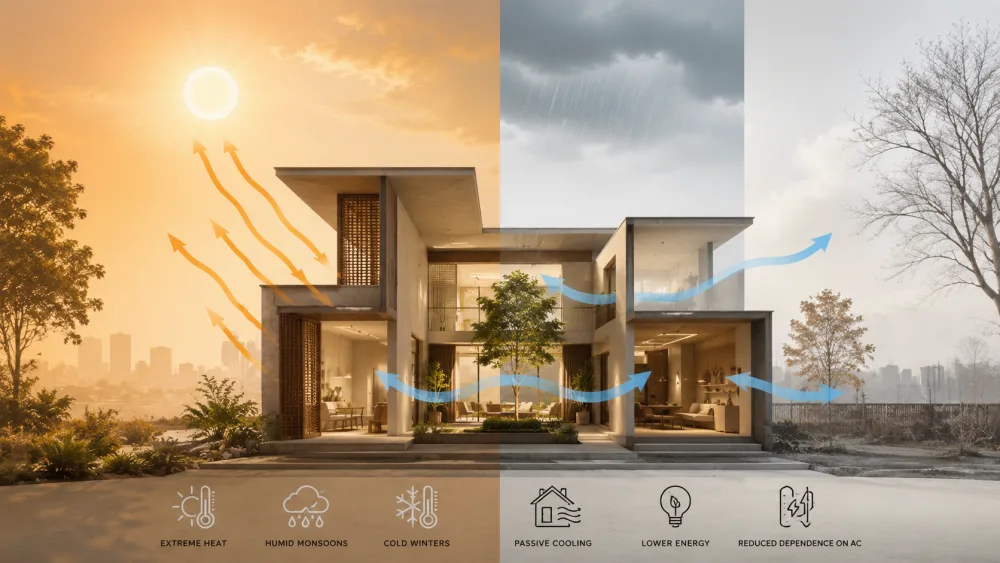
Noida and Delhi sit in what climate scientists call a "composite climate" — and anyone who has lived through a full year here knows exactly what that means. Summers push past 45°C with dry, dust-laden heat; the monsoon brings sticky, humid discomfort; and winters drop cold enough to need heating. Few regions in India demand a building perform well across such extremes within the same calendar year. That's exactly why passive cooling in this region isn't a single trick, but a toolkit of strategies a good architect tailors to your specific plot, orientation, and the realities of Delhi-NCR's summer heat — before a single brick is laid.
The payoff is real: a well-designed passive home can stay several degrees cooler than its surroundings even during a Delhi heatwave, cut cooling-related electricity costs significantly, and reduce dependence on air conditioning that strains both budgets and the grid during peak summer months.
Orientation and Site Planning: The First and Cheapest Decision
The single most powerful passive cooling tool costs nothing extra — it's how you place the building on the plot. Long facades facing east and west catch the harshest low-angle sun; orienting the home so its narrower sides face these directions, with longer walls facing north and south, dramatically reduces heat gain. Where the plot allows, we also study prevailing wind direction so window placement can actually capture the breeze rather than fight it.
This is also where we factor in neighboring structures, existing trees, and water bodies — all of which shape the microclimate around your home long before construction begins.
Courtyards, Cross-Ventilation, and the Stack Effect
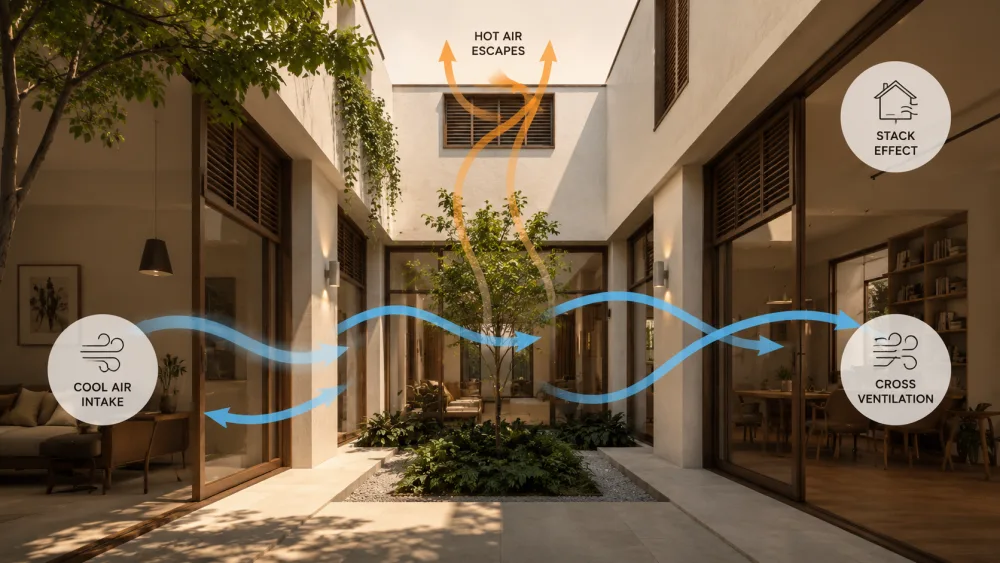
The traditional Indian courtyard wasn't decorative — it was a cooling engine. A central open-to-sky space creates a pressure difference: hot air rises and escapes upward, pulling cooler air in from shaded openings at lower levels. This is the "stack effect," and it works even without a single fan running.
Modern plots are often smaller, but the principle scales down beautifully — a compact internal courtyard, a double-height stairwell with a high vent, or simply windows placed on opposite walls to allow cross-ventilation can replicate the same effect. We frequently design homes with operable high-level vents and lower intake openings specifically to keep air moving through the house, not just into it.
Materials and Roofing: Thermal Mass, Insulation, and Cool Roofs
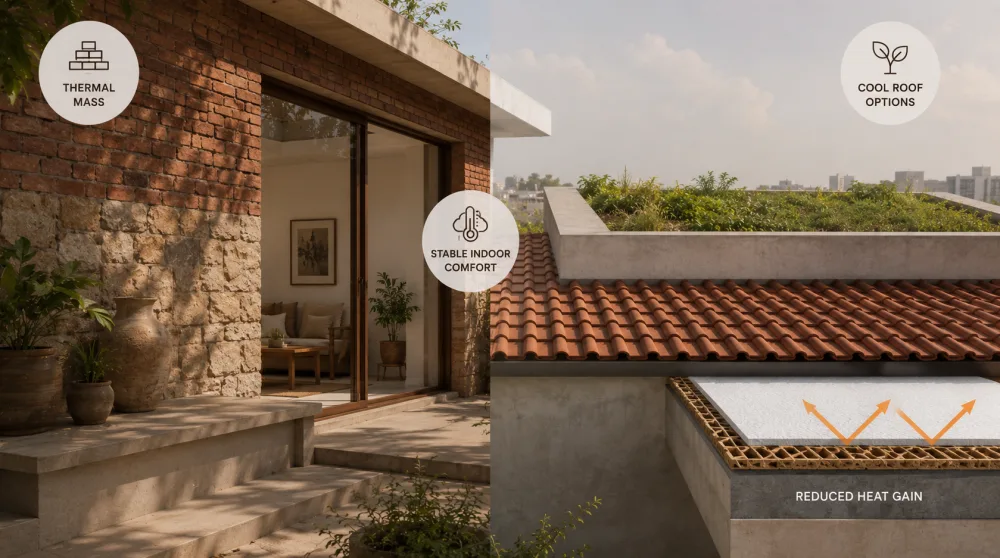
What a wall and roof are made of matters as much as their shape. Materials with high thermal mass — like exposed brick, stone, or rammed earth — absorb heat slowly during the day and release it at night, smoothing out indoor temperature swings. This works especially well in Noida and Delhi, where summer nights cool down enough for that stored heat to discharge before the next day's sun arrives — though during the humid monsoon stretch, good ventilation matters just as much as mass to avoid trapping moisture indoors.
Roofs deserve special attention, since they take the most direct sun. Cool-roof coatings, terracotta tiles with an air gap, or a planted green roof can lower roof surface temperatures dramatically compared to bare concrete, which radiates heat into the rooms below for hours after sunset.
Landscaping and Water Features: Cooling Before the Wall Line
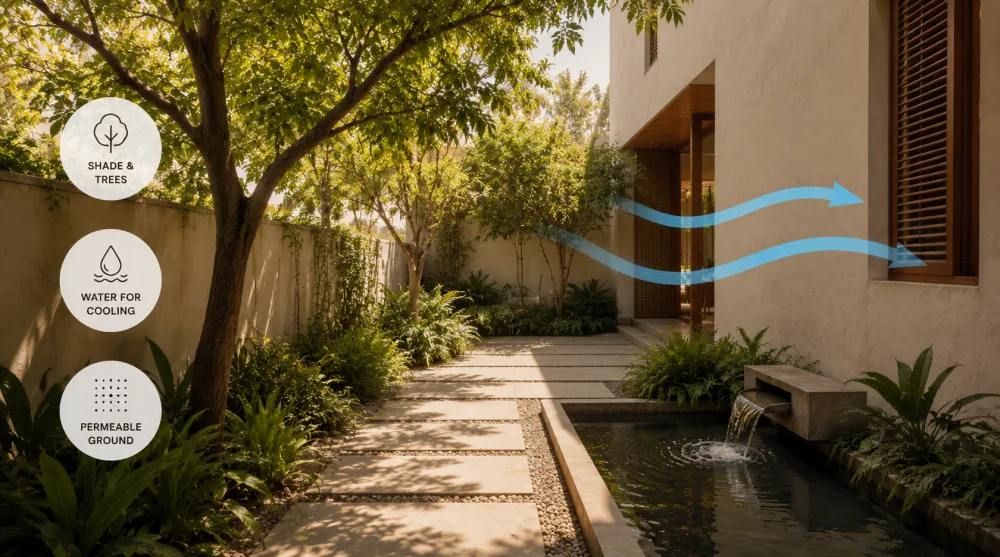
Passive cooling starts outside the building. Deciduous trees positioned to shade west-facing walls in summer, a small water feature near an air intake to cool incoming breeze through evaporation, and permeable ground cover instead of heat-trapping paving all lower the temperature of the air before it ever reaches your walls. These elements also soften a home's visual presence — practical performance and good design working together.
Designing With the Climate, Not Against It
None of these strategies work in isolation, and none of them are guesswork. At New Arch Studios, passive cooling is part of our design process from the first site visit — we study sun paths, wind patterns, and the specific demands of Delhi-NCR's composite climate, and translate that into orientation, openings, shading, and material choices tailored to your home, not copied from a checklist.
The most comfortable, efficient homes we design across Noida and Delhi rarely look radically different from any other beautiful contemporary home — the difference is invisible until you walk inside on a 45°C afternoon and realize you haven't reached for the AC remote.
Thinking about building or renovating a home that works with Delhi-NCR's climate instead of against it? [Get in touch with New Arch Studios] to start a conversation about your site and your vision.